

How We Work.

Here you can find information about how Perspetivo works, our research methodology and the most frequently asked questions.
Our Method

Perspetivo differs from traditional research companies through our approach to collecting data and delivering insights. Our foundation is simple but powerful: good decisions require good data, and good data must reflect the entire population, not just those who are easiest to reach.

Many actors still rely on traditional methods such as phone interviews or registry-based sampling, which often result in low response rates and weighted adjustments after the fact. We have developed a modern methodology that ensures representativeness from the start, meaning the demographics of respondents accurately reflect the population.

About our Surveys

All our surveys are conducted through our platform, allowing us to combine methodological precision with speed.

We use scientifically grounded methods such as stratified and randomized sampling. When needed, respondents are recruited directly for a specific survey via social channels, using the same techniques we apply for our panel recruitment (more on that just below).

Every survey is available in multiple languages and adapted to the target group. Respondents can choose their preferred language, reducing the risk of misunderstanding while strengthening trust and engagement.

Perspetivo conducts continuous quality assurance throughout the entire data collection process. The aggregated demographics of respondents are constantly monitored to ensure that those who respond to the survey accurately represent the target population.

We apply confidence levels and margins of error according to established statistical standards, ensuring that each survey achieves at least a 95% confidence level and a maximum 5% margin of error.

All data is fully anonymized and processed in accordance with GDPR.

About our Panel

Our panel is recruited through stratified digital recruitment models across social media channels, using randomized selection within defined strata and demographics such as culture, language, consumption patterns, and geography. This approach ensures that we reach not only the majority population but also the groups that are often excluded or underrepresented in traditional statistics.

The panel’s demographic composition is continuously monitored to ensure that the full population is represented and has the opportunity to participate in our surveys.

All Perspetivo panel members are verified through BankID upon registration, guaranteeing that every respondent is a real person and that each survey can only be completed once per individual, something that makes us unique in Sweden.

Our platform fully complies with GDPR and industry standards for data security.

In Summary

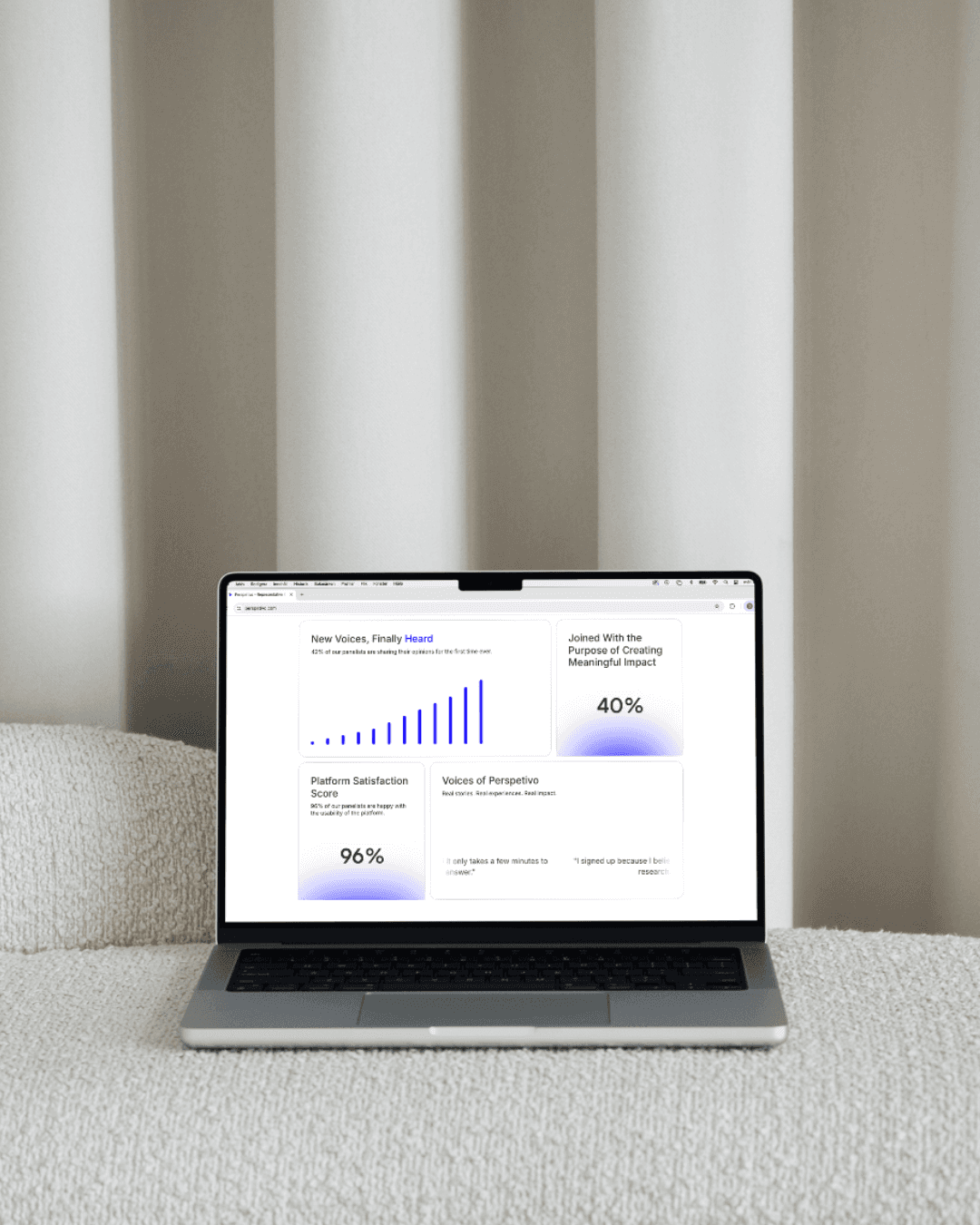
We see data as a democratic issue. When up to 40% of the Nordic population is routinely excluded from traditional surveys, society misses out on perspectives essential to understanding reality.

Perspetivo was built to change that. We create insights that include, that reflect the diversity of society, and that make decision-making more accurate, relevant, and future-proof.

This is what makes us unique, we combine technology, methodology, and a purpose-driven mission to ensure that every voice counts.

FAQ

What is representative data?

Representative data accurately reflects the composition of the group you want to understand, for example, the Swedish population. This means that age, gender, geography, education level, and other relevant variables are proportionally balanced, so that your insights mirror reality rather than skewed or partial views.

Your sample can be sound (i.e., designed to be representative), but the final collected data can drift away from representativeness due to nonresponse, operational issues, or uneven participation.

At Perspetivo, we take active steps to ensure demographic representation, including targeted recruitment, multilingual surveys, and adaptive formats to reach underrepresented groups.

What is representative data?

Representative data accurately reflects the composition of the group you want to understand, for example, the Swedish population. This means that age, gender, geography, education level, and other relevant variables are proportionally balanced, so that your insights mirror reality rather than skewed or partial views.

Your sample can be sound (i.e., designed to be representative), but the final collected data can drift away from representativeness due to nonresponse, operational issues, or uneven participation.

At Perspetivo, we take active steps to ensure demographic representation, including targeted recruitment, multilingual surveys, and adaptive formats to reach underrepresented groups.

What is representative data?

Representative data accurately reflects the composition of the group you want to understand, for example, the Swedish population. This means that age, gender, geography, education level, and other relevant variables are proportionally balanced, so that your insights mirror reality rather than skewed or partial views.

Your sample can be sound (i.e., designed to be representative), but the final collected data can drift away from representativeness due to nonresponse, operational issues, or uneven participation.

At Perspetivo, we take active steps to ensure demographic representation, including targeted recruitment, multilingual surveys, and adaptive formats to reach underrepresented groups.

What is a panel?

A panel is a group of individuals who have voluntarily signed up to participate in surveys. Our panel includes people from across Sweden, covering a wide range of demographics, backgrounds, and life experiences.

Panelists are recruited with quality and diversity in mind, and verified through BankID to ensure every respondent is a real person. They participate anonymously and can opt out at any time.

What is a panel?

A panel is a group of individuals who have voluntarily signed up to participate in surveys. Our panel includes people from across Sweden, covering a wide range of demographics, backgrounds, and life experiences.

Panelists are recruited with quality and diversity in mind, and verified through BankID to ensure every respondent is a real person. They participate anonymously and can opt out at any time.

What is a panel?

A panel is a group of individuals who have voluntarily signed up to participate in surveys. Our panel includes people from across Sweden, covering a wide range of demographics, backgrounds, and life experiences.

Panelists are recruited with quality and diversity in mind, and verified through BankID to ensure every respondent is a real person. They participate anonymously and can opt out at any time.

What is a dashboard?

A dashboard is a digital analysis tool where you can view your survey results in real time. It typically includes:

  • Summary statistics

  • Filter options by demographic factors and/or specific answers

  • Export functions for data and reports

With Perspetivo’s dashboards, you can easily explore, compare and act on your insights, without needing to manually dig through spreadsheets.

What is a dashboard?

A dashboard is a digital analysis tool where you can view your survey results in real time. It typically includes:

  • Summary statistics

  • Filter options by demographic factors and/or specific answers

  • Export functions for data and reports

With Perspetivo’s dashboards, you can easily explore, compare and act on your insights, without needing to manually dig through spreadsheets.

What is a dashboard?

A dashboard is a digital analysis tool where you can view your survey results in real time. It typically includes:

  • Summary statistics

  • Filter options by demographic factors and/or specific answers

  • Export functions for data and reports

With Perspetivo’s dashboards, you can easily explore, compare and act on your insights, without needing to manually dig through spreadsheets.

What is statistical significance?

A measure used in statistics to decide whether a result is extreme enough that it likely didn’t occur by chance. If a result is statistically significant, it usually means there is a real effect or difference.

What is statistical significance?

A measure used in statistics to decide whether a result is extreme enough that it likely didn’t occur by chance. If a result is statistically significant, it usually means there is a real effect or difference.

What is statistical significance?

A measure used in statistics to decide whether a result is extreme enough that it likely didn’t occur by chance. If a result is statistically significant, it usually means there is a real effect or difference.

What is a sample?

A sample is the group of people selected from a larger population to participate in a survey.

Instead of asking everyone in your target group (e.g. all adults in Sweden), you ask a smaller group - the sample.

For the data to be reliable, the sample must be representative of the larger population. This means that key characteristics like age, gender, geography, and other factors are proportionally included, not over- or underrepresented.

What is a sample?

A sample is the group of people selected from a larger population to participate in a survey.

Instead of asking everyone in your target group (e.g. all adults in Sweden), you ask a smaller group - the sample.

For the data to be reliable, the sample must be representative of the larger population. This means that key characteristics like age, gender, geography, and other factors are proportionally included, not over- or underrepresented.

What is a sample?

A sample is the group of people selected from a larger population to participate in a survey.

Instead of asking everyone in your target group (e.g. all adults in Sweden), you ask a smaller group - the sample.

For the data to be reliable, the sample must be representative of the larger population. This means that key characteristics like age, gender, geography, and other factors are proportionally included, not over- or underrepresented.

What is “margin of error”?

The margin of error tells you how much your survey results might differ from the actual views of the entire population. It’s expressed as a percentage, and the smaller the margin, the more precise the results.

For example, if a result is 52% with a ±3% margin of error, the true value could be between 49% and 55%. The margin depends on the sample size, larger samples tend to have smaller margins of error.

What is “margin of error”?

The margin of error tells you how much your survey results might differ from the actual views of the entire population. It’s expressed as a percentage, and the smaller the margin, the more precise the results.

For example, if a result is 52% with a ±3% margin of error, the true value could be between 49% and 55%. The margin depends on the sample size, larger samples tend to have smaller margins of error.

What is “margin of error”?

The margin of error tells you how much your survey results might differ from the actual views of the entire population. It’s expressed as a percentage, and the smaller the margin, the more precise the results.

For example, if a result is 52% with a ±3% margin of error, the true value could be between 49% and 55%. The margin depends on the sample size, larger samples tend to have smaller margins of error.

What is confidence level?

The confidence level shows how certain you can be that the survey results fall within the margin of error. The most common level is 95%, which means that if the same survey were conducted 100 times, the results would fall within the stated margin 95 of those times.

In short: A 95% confidence level means you can trust that your insights are statistically solid, within a known margin of uncertainty.

What is confidence level?

The confidence level shows how certain you can be that the survey results fall within the margin of error. The most common level is 95%, which means that if the same survey were conducted 100 times, the results would fall within the stated margin 95 of those times.

In short: A 95% confidence level means you can trust that your insights are statistically solid, within a known margin of uncertainty.

What is confidence level?

The confidence level shows how certain you can be that the survey results fall within the margin of error. The most common level is 95%, which means that if the same survey were conducted 100 times, the results would fall within the stated margin 95 of those times.

In short: A 95% confidence level means you can trust that your insights are statistically solid, within a known margin of uncertainty.

What is stratified sampling?

Stratified data is based on stratified sampling, where the population is divided into homogeneous subgroups (strata). A random sample is then drawn within each stratum, often in proportion to its share of the population.

The result is a dataset where key variables are correctly represented, reducing sampling error and increasing the precision of estimates, especially for subgroups.

What is stratified sampling?

Stratified data is based on stratified sampling, where the population is divided into homogeneous subgroups (strata). A random sample is then drawn within each stratum, often in proportion to its share of the population.

The result is a dataset where key variables are correctly represented, reducing sampling error and increasing the precision of estimates, especially for subgroups.

What is stratified sampling?

Stratified data is based on stratified sampling, where the population is divided into homogeneous subgroups (strata). A random sample is then drawn within each stratum, often in proportion to its share of the population.

The result is a dataset where key variables are correctly represented, reducing sampling error and increasing the precision of estimates, especially for subgroups.

What is weighting?

Weighting is a method used to assign different factors or data points different degrees of importance, or “weight”, in a calculation or analysis. By applying weights, you can control how much each factor contributes to the final result or balance uneven datasets.

In survey contexts, weighting is often used to adjust the data and balance demographic factors. This has become especially common in studies where collecting representative data, data that reflects the entire target population, is difficult. Perspetivo do not use weighting but only real representation.

What is weighting?

Weighting is a method used to assign different factors or data points different degrees of importance, or “weight”, in a calculation or analysis. By applying weights, you can control how much each factor contributes to the final result or balance uneven datasets.

In survey contexts, weighting is often used to adjust the data and balance demographic factors. This has become especially common in studies where collecting representative data, data that reflects the entire target population, is difficult. Perspetivo do not use weighting but only real representation.

What is weighting?

Weighting is a method used to assign different factors or data points different degrees of importance, or “weight”, in a calculation or analysis. By applying weights, you can control how much each factor contributes to the final result or balance uneven datasets.

In survey contexts, weighting is often used to adjust the data and balance demographic factors. This has become especially common in studies where collecting representative data, data that reflects the entire target population, is difficult. Perspetivo do not use weighting but only real representation.

What is non-response?

Non-response is the term for when people in your sample don’t answer your survey.

Example: You invite 100 people and 70 respond. The non-response is 30%.

What is non-response?

Non-response is the term for when people in your sample don’t answer your survey.

Example: You invite 100 people and 70 respond. The non-response is 30%.

What is non-response?

Non-response is the term for when people in your sample don’t answer your survey.

Example: You invite 100 people and 70 respond. The non-response is 30%.

How do you comply with GDPR?

Perspetivo fully complies with the General Data Protection Regulation (GDPR). Key practices include:

  • Explicit, informed consent from panelists

  • Anonymization of survey responses

  • Secure data storage within the EU (Sweden and Germany)

  • No tracking, resale, or third-party targeting

  • Right to access, correct or delete personal data

  • Strict internal data access policies

  • No automated decision-making based on personal data

  • We don’t save cookies and we don’t use IP tracking

We also appoint a Data Protection Officer (DPO) who oversees all compliance and security matters. For more information, see our Privacy Policy.

How do you comply with GDPR?

Perspetivo fully complies with the General Data Protection Regulation (GDPR). Key practices include:

  • Explicit, informed consent from panelists

  • Anonymization of survey responses

  • Secure data storage within the EU (Sweden and Germany)

  • No tracking, resale, or third-party targeting

  • Right to access, correct or delete personal data

  • Strict internal data access policies

  • No automated decision-making based on personal data

  • We don’t save cookies and we don’t use IP tracking

We also appoint a Data Protection Officer (DPO) who oversees all compliance and security matters. For more information, see our Privacy Policy.

How do you comply with GDPR?

Perspetivo fully complies with the General Data Protection Regulation (GDPR). Key practices include:

  • Explicit, informed consent from panelists

  • Anonymization of survey responses

  • Secure data storage within the EU (Sweden and Germany)

  • No tracking, resale, or third-party targeting

  • Right to access, correct or delete personal data

  • Strict internal data access policies

  • No automated decision-making based on personal data

  • We don’t save cookies and we don’t use IP tracking

We also appoint a Data Protection Officer (DPO) who oversees all compliance and security matters. For more information, see our Privacy Policy.

Do you have questions?

Do you want to know more about how we work and our methodology?

Do you have questions?

Do you want to know more about how we work and our methodology?

Do you have questions?


Do you want to know more about how we work and our methodology?

Business Plans

Logo

National surveys.

Subscription Standard

National surveys (min. 1,000 respondents)

Interactive dashboards

Up to 4 surveys/year (20–25 questions each)

Up to 2 pulse surveys/year (3–5 questions each)

Logo

National and targeted surveys.

Subscription Plus

National surveys (min. 1,000 respondents)

Target group or area-specific surveys

Interactive dashboards

Up to 6 surveys/year (20–25 questions each)

Up to 3 pulse surveys/year (3–5 questions each)

Yearly report with trends & key findings

Logo

Single Surveys

Try Perspetivo

One-time national survey (min. 1,000 respondents)

Interactive dashboard included

Want to stay updated?

Get updates, accurate insights and what’s new on Perspetivo.

Sign me up

Perspetivo AB

Org. 559378-5818

Jakobsbergsgatan 24
111 44 Stockholm

Want to stay updated?

Get updates, accurate insights and what’s new on Perspetivo.

Sign me up

Perspetivo AB

Org. 559378-5818

Jakobsbergsgatan 24
111 44 Stockholm

Want to stay updated?

Get updates, accurate insights and what’s new on Perspetivo.

Sign me up

Perspetivo AB

Org. 559378-5818

Jakobsbergsgatan 24
111 44 Stockholm